Showing posts with label google adsense quide. Show all posts
Adbrite will aso pay you money like GOOGLE ADSENCE.!!!!...HURRY!!!!!

Category filtering feature being developed
Monday, October 19, 2009
Category filtering will give publishers the ability to block ads that fall into specific categories such as dating, religion, and politics. Regardless of how ads are targeted, they'll be filtered if they're within one of the selected categories. We'll also show the percentage of recent revenue that ads in each category generate, so publishers can predict how filtering selections will impact their revenue.
We'll be launching category filtering as a beta to a small group of publishers to collect initial feedback about the feature. Here's a preview of what the feature currently looks like, but please keep in mind that the layout and categories may change based on feedback from beta test participants.

Although we're not able to expand the limited beta to additional publishers at this point, we wanted to give you a glimpse into one of the ways we're working to give you more control over your ads so you can ensure a positive experience for your users. We'll continue to refine this feature, and hope to be able to roll it out more widely in coming months. Please stay tuned to the blog for any updates, and feel free to leave us a comment in the meantime.


Your introduction to Google Ad Manager (Part 1 of 2)
What is Google Ad Manager?
Google Ad Manager is a hosted ad management solution for publishers with smaller direct sales teams; it can help you sell, schedule, deliver, and measure all of your directly sold and network-based inventory.
Should I use Ad Manager?
You'll probably want to use Ad Manager if:
- You operate a website and sell your ad inventory directly to advertisers (or plan to sell directly to advertisers in the future).
- You'd like to improve the efficiency of your sales process and feel confident in your forecasting.
- You've been left with unsold inventory because you weren't able to forecast availability accurately.
- You need a consistent way to serve ads that make you the most money in undersold situations.
- A simple, intuitive user interface: you can manage your campaigns, inventory, and advertiser data quickly and efficiently.
- Revenue optimization and AdSense integration: the system will consistently deliver the highest-paying ad for every ad impression on your site.
- Precise inventory forecasting: you'll be able to sell more of your inventory without overbooking it.
Using AdSense with Ad Manager on your websites can help you maximize your revenue in a number of ways. You can use AdSense to backfill all of your unsold inventory, ensuring that all of your ad spaces are filled. AdSense can also be used as a competing network against your other networks -- AdSense can compete with your remnant and house campaigns to deliver the highest value ads, and an AdSense ad will only show if it can pay you more than any alternative ads.
Moreover, since AdSense is integrated in your Ad Manager account, the only thing you need to do is to choose the Ad Slots for which you want to enable AdSense. You can modify your AdSense settings within Ad Manager, and you can manage your visibility to advertisers by using the placement targeting feature.
How do I get started with Ad Manager?
You can create an account by visiting the Ad Manager homepage and using your AdSense login. Once you've done so, don't forget to visit our Help Center for detailed instructions and video tutorials on getting started. We also recommend taking a look at how Ad Manager works.
In Part 2 of this series, we'll help you get accustomed to your new Ad Manager account and guide you through the creation of your first campaign. We're also hosting a Getting Started with Google Ad Manager Webinar on April 21st at 11:00 am PDT, where we'll give a live demo of Ad Manager, share best practices, and help you get started. Sign up at: https://googleonline.webex.com/googleonline/onstage/g.php?t=a&d=570486361.
New email notification preferences to keep you informed
What does that mean? Simply put, you'll soon have the option to receive specific messages like event invitations, information about webinars, and personalized account suggestions from members of our team.

In a few days, you'll be prompted with a one-time interstitial page after you sign in, which will ask you to select the types of messages you'd like to receive from us. We encourage you to take the new email preferences out for a spin once they're available in your account. If you change your mind, you're welcome to update your selections at any time. Just sign in to your account and visit the Contact Preferences section of your Account Settings page to update the types of emails you want to receive.
Sunsetting video units feature
If you'd still like to display video content from YouTube, you can do so through YouTube.com directly. Visit any specific video page and look for the code in the 'Embed' box, or sign in to your YouTube account to create a playlist. In addition, please note that this change won't affect the availability of other video-related ads options -- video ads may appear in your AdSense for content ad units if you've opted into image ads, and AdSense for video is still accepting applications from eligible publishers who produce video content.
Starting today, the option to sign up for video units is no longer available to new publishers. If you're currently displaying video units, we recommend that you start removing the video unit code from your pages as soon as possible so you can optimize your available ad space in advance. Please be assured that any earnings you've generated from video units in the past will still be credited to your AdSense account.
Once video units are retired at the end of April, any remaining Leaderboard or Skyscraper video units on your pages will direct users to YouTube.com, while other video unit sizes will automatically be changed to standard embedded YouTube players. These standard video players will display top YouTube videos, but you won't generate earnings from them once this change occurs. If you have less than three ad units on your page, you may prefer to replace your video unit with a regular ad unit.
Pageview tracking back to normal
Please be assured that ad unit impressions were still logged correctly and ads were still displayed on your pages, so you were properly credited for all earnings generated from your ads. We've resolved the issue, and although you won't see the pageview count in your reports retroactively changed, your pageview tracking is now back to normal.
Thanks for your patience and your help in identifying this bug.
AdSense is a-Twitter
We're thrilled to launch @adsense to communicate with AdSense publishers who use Twitter. Our tweets will be a mix of fresh product news, optimization tips, interesting links, upcoming events, and possibly even pictures of our dogs. Our entire AdSense team contributes, so if you have any suggestions for what you want to see, feel free to send an @reply to us!
Please note that since we want to make this feed as useful as possible to everyone following us, we can't respond via Twitter to questions regarding individual AdSense accounts. Please continue to visit the AdSense Help Center and Help Forum to troubleshoot your specific issues.
Driving monetization with ads that reach the right audience
Over the next few months we'll start offering interest-based advertising to a limited number of advertisers as part of a beta, and expand the offering later in 2009. Whether the advertiser's goal is to drive brand awareness or increase responses to their ads, these capabilities can help expand the success of their campaigns and should increase your earnings as advertiser participation increases.
To develop interest categories, we'll recognize the types of webpages users visit across the AdSense network. As an example, if they visit a number of sports pages, we'll add them to the "sports enthusiast" interest category. You can visit the Help Center to learn more about how interest categories will be developed and your associated account settings. As a result of this launch, your privacy policy will now need to reflect the use of interest-based advertising. Please ensure that your site's privacy policies are up-to-date and make any necessary changes by April 8, 2009.
Users browsing the web will benefit from the additional relevancy that interest-based ads can provide. And by visiting the new Ads Preferences Manager, users can see what interest categories we think they fall into, or add and remove categories themselves. The Ads Preferences Manager can be found by clicking on most "Ads by Google" links you see on Google ads throughout the web.
You can read more about how interest-based advertising benefits the online ecosystem and about the privacy innovations developed for this launch in the Official Google Blog and the Google Public Policy Blog.
We look forward to providing users with ads more closely tied to their interests, helping advertisers reach their campaign goals, and helping you to monetize your website most effectively.
Answers to your interest-based advertising questions
How should I update my privacy policies?
Your site's privacy policy will need to include the information mentioned in this Help Center entry. However, because publisher sites and laws vary by country, we're not able to provide exact language for your site. Please make any necessary changes to your privacy policies by April 8th, 2009, as the official launch of interest-based advertising will occur on April 9th. If you're a blogger, you can paste your privacy policy into your sidebar.
I noticed some changes in my earnings and the ads showing up on my site -- is it because of interest-based ads?
No. We haven't yet launched interest-based ads on AdSense publisher sites, so there's been no effect on your revenue or the ads appearing on your pages. Interest-based advertising will be rolled out to a limited set of advertisers beginning on April 9th, and then expanded later this year; as a result, the impact of this launch for most publishers won't be immediate. Over time, as interest-based advertising is rolled-out to additional advertisers, you should begin to see positive effects on your revenue.
Does this mean that my sites won't show ads relevant to my content anymore?
No, that's not the case -- interest-based ads won't replace the previous ad targeting options you're used to. Interest-based ads will compete in the same ad auction as contextually- and placement-targeted ads, and we'll continue to show only the ad(s) that will generate highest earnings for you. As noted above, interest-based ads will gradually become available to show on publisher pages, and with more available ads competing in the ad auction, you should see increased earnings over time.
Are these interest-based ads pop-ups?
No, Google doesn't show ads as pop-ups.
If I opt out of showing ads based on interest categories, can I change my mind later? Will I still need to update my privacy policy now?
Yes, you can change your preferences around displaying ads based on interest categories at any time. However, even if you choose to opt out of displaying ads based on interest categories now, you'll still need to update your privacy policies by April 8th. This is because your site may still show ads based on a user's previous interactions with an advertiser, such as past visits to that advertiser's site. Please keep in mind that remaining opted in to displaying ads based on interest categories will help increase the number of available ads for your pages in the long run, which can help increase your earnings potential.
Introducing expandable ads on AdSense sites
We're excited to introduce to you expandable ads, a new type of ad that can appear on your pages. Expandable ads are rich media ads that can expand beyond the original size of the ad unit, following a user-initiated action. This creates more real estate for the ad, allowing for more interaction from interested users. For instance, expandable ads may stream a movie trailer, show video game clips, or display various views of an item for sale.
Expandable ads will be served as third-party ads and will be created by Google-certified rich media vendors for the top display advertisers in our network. And like other Google ads, you'll earn based on whether the expandable ads on your site are priced on a cost-per-click (CPC) or cost-per-impression (CPM) basis. Keep in mind that you'll generate earnings from CPC expandable ads when a user visits the advertiser's landing page, and not when a user simply clicks to expand the ad.

We thought you might have more questions about the launch of expandable ads, so we've addressed a few key points below:
Will expandable ads alter my site's layout or be disruptive to my users?
No. In order to protect the publisher and user experience, we've created several policies around how expandable ads work:
- Ads will expand only after a user clicks and interacts with the ad. Mouseovers or rollovers won't trigger the ad, in order to prevent accidental expansions.
- An expandable ad won't expand more than double its width or height.
- Once expanded, the ad will appear as a layer over the page content so that your content will not be modified or shifted in any way.
- The user may close the expanded panel at any time.
- All expandable ads must comply with our standard AdWords image ad policies.
You're automatically eligible to receive expandable ads if you've added the AdSense code directly into your site's source code and you've enabled image ads. Please note that expandable ads are currently only available to specific advertisers located in the U.S., who can bid on specific sites where they'd like their ads to appear.
You won't need to upload any special "iFrame-buster" files from third-party vendors onto your own servers to allow these new types of ads to expand on your site. Although we don't currently offer expandable ads for all ad serving solutions, we're actively working to support more implementation methods soon, and we thank you for your patience in the meantime.
Can I filter specific expandable ads shown on my site?
Yes - like the other ads on your pages, you can use your Competitive Ad Filter to block contextually-targeted expandable ads. Please note that for third-party ads, we recommend using the top level domain (e.g. 'example.com' instead of 'example.com/sample.html'). Additionally, you'll still be able to use your Ad Review Center to block specific placement-targeted expandable ads. In the Ad Review Center, expandable ads will be classified under the "Rich Media" ad format.
Updates on account access and reporting
Login loop
If you tried to sign in to your AdSense account between 10:45 and 11:35 p.m. PST last night, you may have found yourself in a "loop" between the AdSense login page and your Google Accounts page. We're in the process of trying out some new designs for our US English homepage, and we rolled them back after users reported a login error with one of the designs. If you're still having trouble accessing your account, please clear your cache and cookies and then try logging in again at http://www.google.com/adsense. Rest assured the next time the new designs are rolled out, you'll actually end up where you want to be: in your AdSense account! Thanks especially to the forum posters and Twitterers for quickly bringing this to our attention.
Slower stats
You may notice more of a delay in your AdSense and Google Ad Manager stats than usual today, as our engineers will be performing some maintenance work on our system. Please be assured that ads will continue to be served to your pages, and all activity will continue to be tracked as usual. Although it may take longer than usual to see impressions, clicks, and earnings reported in your account, you'll be credited for all valid activity on your sites. We apologize for the short notice, and appreciate your patience as we work to keep our systems updated for you.
Reports have gone international
If you're located in one of these five countries and make this update, we'll convert your earnings to Euros on a daily basis using the prevailing market rate from the previous day. With earnings converted daily, you'll avoid the risk of currency exchange fluctuations between USD and the Euro. You can still choose to receive payments in either Euros or U.S. Dollars and select from a range of payment methods as well.
To make the switch to local currency reports, you'll need to agree to a new set of Terms and Conditions. Here are the main changes involved:
- The party that publishers are contracting with changes from Google Inc. to Google Ireland Limited.
- Publishers are responsible for paying any local taxes in their jurisdiction. Google will only issue VAT refunds to publishers with an address in Ireland.
- The governing law changes from California law to either English or local law.
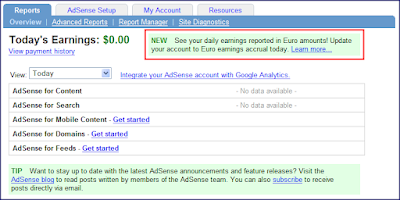
Before agreeing to the new Terms, we also recommend that you download and save copies of your past reports in U.S. Dollars for your records. Once you update your account, you'll be able to view current and historical reports only in Euros. However, you'll still be able to view your prior payment history of U.S. Dollar earnings.
We encourage you to update your account to local currency reports soon, as we may require this change in the future. If we're able to offer this to publishers in other countries, we'll provide details here on Inside AdSense. For more information, please feel free to visit our Help Center.
Get Goghing with AdSense for search
VanGoghGallery.com is an art resource site that provides information about the life and work of Vincent van Gogh. Site owner Greg Alexander runs the Van Gogh Gallery to educate and share information about the artist, and has also used the site to explore new Internet marketing techniques. Greg joined AdSense in 2007, and although he didn't know much about the program at first, he found it "a great opportunity to generate some revenue without spending the effort to sell ads." He also tried other ad providers, "but none of them yielded the results that AdSense did. In addition, AdSense was the only one that provided relevant ads for our visitors."
To help users navigate through the many pages of the Van Gogh Gallery, Greg added an AdSense for search box to the right column of his pages. By enabling SiteSearch and displaying search results on his own pages, he was able to help users find what they were looking for while staying on his site.
As an optimization experiment, Greg recently moved his search box to the center column of his pages and extended it to twice its original width.
Before
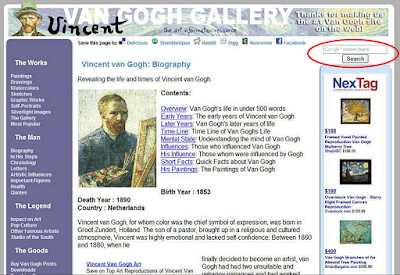
After

In addition, Greg made slight changes to the search results pages -- he removed the borders from the ads and search results, and added a new search box to the search results pages. According to Greg, "altogether, these changes took less than 15 minutes to do."
After making these updates, Greg noticed a dramatic and immediate increase in the usage of search on the Van Gogh Gallery. He found that "the number of queries performed each day increased 8 to 10 times, and search ad clicks and revenues increased even more." His search earnings quickly grew from less than a dollar a day to double digits since his optimization test. "Now we frequently receive more search ad clicks than our total number of searches pre-optimization," says Greg. "I'm still amazed at how simple changes can have such an incredible impact."
Greg has started using the earnings from his AdSearch optimization efforts to build and host additional websites about other artists. "Ultimately," Greg says,"we hope to use the earnings to fund research trips to Europe to see the works of the masters and expand the quality of information we offer visitors to our sites."
The Google AdSense Payment Guide
Wednesday, May 27, 2009
 Wish to set up an account with Google AdSense or confused and thinking hard about it? When your check arrives, check out this Google AdSense payment guide. This guide contains all the requisite information that you need to know, including the payment cycle of AdSense.
To start with, you need to set up an account with AdSense. Fill the online form, provide your personal information, furnish all tax details, select a mode of payment, enter PVN (phone verification number) and PIN (personal identification number). After furnishing these details, your account gets set up in Google AdSense.
When you generate an unpaid income of $100, Google sends you the payment check. For instance, if your entire unpaid income reaches $100 in January and you have furnished all the details as mentioned above, then you get a payment check in February end.
However, if your unpaid income has not touched the $100 mark, whatever earnings you have generated gets rollover to subsequent month. The amount accrues until total earnings reach $100. After this, you will receive the payment within 30 days.
How to Track the Income:
You can easily track your AdSense performance and income through the reports tab present in your account. This tab has, two more sub tabs, overview reports and advanced reports. To get general information of your income, refer to the overview tab. If you want comprehensive details of your account, go through advanced tabs.
To check previous records of the payment, refer to payment history. Now, click the link that reads out earning details. Check this link to know about payment details of each month. However, your name appears on the link only after you receive the first payment.
You can also view exchange rate to convert the payment in your local currency and check whether you have received the payments accordingly.
How to Calculate the Earnings:
At the last day of each month, Google AdSense system identifies your account and checks for generated amount, which has to be at least $100. Now, if your account contains $100 or may be more than that, the account is sent for verification and approval. Within few days of the subsequent month, the system sends you all details, which you can view by checking the history page.
Earning Issues:
After few days, the system processes your income and sends your payment, depending on the mode of payment you have chosen. If you do not receive this payment within 30 days or until 25th of next month, you will need to apply for reissue.
How to Hold the Payments:
If you do not wish to receive your check the other month, opt for payment holding. Here you just need to set up a self-hold in AdSense account. Although, you will not receive the unpaid income, the system accrues your earlier earnings. However, if you want to hold your account, you need to make the changes before 15th of the ongoing month. Thus, you can keep a track of your Google AdSense payments.
how do you get approved adsense account?

In earlier we have discussed everything about google adsense and you should know every things that how to make money online with adsense.
This lesson is guide you step by step to begin make money online with google adsense program
Understanding Google policies
We discussed earlier every things about the Google AdSense program.
However, joining the Google AdSense program is not that easy or everyone in
the world would do it (which would defeat its purpose, ultimately). You have to be
approved by Google in order to create your AdSense account and start earning
money from adsense.
How do you get approved?
Google famously has never publicly published details of its approval process,
but there are tips you should follow to ensure a high possibility of getting approved.
The good news is that Google does publish its policies and you do not need to be
a member to read them. You should read them and be certain that you are in
100% compliance with them, not only when attempting to start your AdSense
account, but once you are already a member. They update these policies
regularly and a violation will get you suspended. A list of Google AdSense
policies can be seen at: google adsense policies
Content – always be the king I think this is always for future time and this is The Key to AdSense program!
i think you often heard that content is king, content and content.
As stated earlier, we cannot say exactly how Google decides to accept or reject a
site. However, one thing is for sure – the main criterion for approval is always the
content of the website!
Most sites get rejected simply because they do not have any – or enough – good
content. What constitutes “good” content? We can say what it is not.
The types of websites that only have links and “filler” content aimed at attracting Search
Engines, and sites that do not offer any informational content but solely focus on
their own products and services. Google is one of the smartest companies on the
Internet, and they can easily tell “junk” content from “real” content, even if many
web surfers themselves can’t.
Google approves websites that have significant real content. These could be in
the form of informational articles, analyses of various topics, and much more. For
business websites that solely focus on selling their products and services through
their website, including informational articles about their industry is smart, and
this data is usually pretty easily available.
Another reason why most business websites do not qualify for the program, is
that most businesses are specialized, and these websites are most likely to get
ads from their competitors, as only those ads would be relevant. As discussed,
competitor ads would be blocked by you, filtered by Google, or both, so an
AdSense program that serves no ads makes no sense!
Similarly, websites that focus only on links for generating search engine traffic do
not have any content at all. According to both common sense and Google, these
sites may rack up fairly high traffic scores and so forth, but they do not qualify for
AdSense.
One of the best and simplest strategies is to include at least 30 to 40
informational articles of 400 to 450 words each and update them from time to
time. Writing these articles yourself may be a daunting task. However, the good
news is that there are considerable websites that offer articles for free, and plenty
of professional writing resources who can not only write high quality material for
you, but can especially optimize that material to work well with search engines
and the “qualification” processes for systems like AdSense.

