Showing posts with label Google AdSense. Show all posts
Adbrite will aso pay you money like GOOGLE ADSENCE.!!!!...HURRY!!!!!

Category filtering feature being developed
Monday, October 19, 2009
Category filtering will give publishers the ability to block ads that fall into specific categories such as dating, religion, and politics. Regardless of how ads are targeted, they'll be filtered if they're within one of the selected categories. We'll also show the percentage of recent revenue that ads in each category generate, so publishers can predict how filtering selections will impact their revenue.
We'll be launching category filtering as a beta to a small group of publishers to collect initial feedback about the feature. Here's a preview of what the feature currently looks like, but please keep in mind that the layout and categories may change based on feedback from beta test participants.

Although we're not able to expand the limited beta to additional publishers at this point, we wanted to give you a glimpse into one of the ways we're working to give you more control over your ads so you can ensure a positive experience for your users. We'll continue to refine this feature, and hope to be able to roll it out more widely in coming months. Please stay tuned to the blog for any updates, and feel free to leave us a comment in the meantime.


Your introduction to Google Ad Manager (Part 1 of 2)
What is Google Ad Manager?
Google Ad Manager is a hosted ad management solution for publishers with smaller direct sales teams; it can help you sell, schedule, deliver, and measure all of your directly sold and network-based inventory.
Should I use Ad Manager?
You'll probably want to use Ad Manager if:
- You operate a website and sell your ad inventory directly to advertisers (or plan to sell directly to advertisers in the future).
- You'd like to improve the efficiency of your sales process and feel confident in your forecasting.
- You've been left with unsold inventory because you weren't able to forecast availability accurately.
- You need a consistent way to serve ads that make you the most money in undersold situations.
- A simple, intuitive user interface: you can manage your campaigns, inventory, and advertiser data quickly and efficiently.
- Revenue optimization and AdSense integration: the system will consistently deliver the highest-paying ad for every ad impression on your site.
- Precise inventory forecasting: you'll be able to sell more of your inventory without overbooking it.
Using AdSense with Ad Manager on your websites can help you maximize your revenue in a number of ways. You can use AdSense to backfill all of your unsold inventory, ensuring that all of your ad spaces are filled. AdSense can also be used as a competing network against your other networks -- AdSense can compete with your remnant and house campaigns to deliver the highest value ads, and an AdSense ad will only show if it can pay you more than any alternative ads.
Moreover, since AdSense is integrated in your Ad Manager account, the only thing you need to do is to choose the Ad Slots for which you want to enable AdSense. You can modify your AdSense settings within Ad Manager, and you can manage your visibility to advertisers by using the placement targeting feature.
How do I get started with Ad Manager?
You can create an account by visiting the Ad Manager homepage and using your AdSense login. Once you've done so, don't forget to visit our Help Center for detailed instructions and video tutorials on getting started. We also recommend taking a look at how Ad Manager works.
In Part 2 of this series, we'll help you get accustomed to your new Ad Manager account and guide you through the creation of your first campaign. We're also hosting a Getting Started with Google Ad Manager Webinar on April 21st at 11:00 am PDT, where we'll give a live demo of Ad Manager, share best practices, and help you get started. Sign up at: https://googleonline.webex.com/googleonline/onstage/g.php?t=a&d=570486361.
New email notification preferences to keep you informed
What does that mean? Simply put, you'll soon have the option to receive specific messages like event invitations, information about webinars, and personalized account suggestions from members of our team.

In a few days, you'll be prompted with a one-time interstitial page after you sign in, which will ask you to select the types of messages you'd like to receive from us. We encourage you to take the new email preferences out for a spin once they're available in your account. If you change your mind, you're welcome to update your selections at any time. Just sign in to your account and visit the Contact Preferences section of your Account Settings page to update the types of emails you want to receive.
Sunsetting video units feature
If you'd still like to display video content from YouTube, you can do so through YouTube.com directly. Visit any specific video page and look for the code in the 'Embed' box, or sign in to your YouTube account to create a playlist. In addition, please note that this change won't affect the availability of other video-related ads options -- video ads may appear in your AdSense for content ad units if you've opted into image ads, and AdSense for video is still accepting applications from eligible publishers who produce video content.
Starting today, the option to sign up for video units is no longer available to new publishers. If you're currently displaying video units, we recommend that you start removing the video unit code from your pages as soon as possible so you can optimize your available ad space in advance. Please be assured that any earnings you've generated from video units in the past will still be credited to your AdSense account.
Once video units are retired at the end of April, any remaining Leaderboard or Skyscraper video units on your pages will direct users to YouTube.com, while other video unit sizes will automatically be changed to standard embedded YouTube players. These standard video players will display top YouTube videos, but you won't generate earnings from them once this change occurs. If you have less than three ad units on your page, you may prefer to replace your video unit with a regular ad unit.
Pageview tracking back to normal
Please be assured that ad unit impressions were still logged correctly and ads were still displayed on your pages, so you were properly credited for all earnings generated from your ads. We've resolved the issue, and although you won't see the pageview count in your reports retroactively changed, your pageview tracking is now back to normal.
Thanks for your patience and your help in identifying this bug.
AdSense is a-Twitter
We're thrilled to launch @adsense to communicate with AdSense publishers who use Twitter. Our tweets will be a mix of fresh product news, optimization tips, interesting links, upcoming events, and possibly even pictures of our dogs. Our entire AdSense team contributes, so if you have any suggestions for what you want to see, feel free to send an @reply to us!
Please note that since we want to make this feed as useful as possible to everyone following us, we can't respond via Twitter to questions regarding individual AdSense accounts. Please continue to visit the AdSense Help Center and Help Forum to troubleshoot your specific issues.
Driving monetization with ads that reach the right audience
Over the next few months we'll start offering interest-based advertising to a limited number of advertisers as part of a beta, and expand the offering later in 2009. Whether the advertiser's goal is to drive brand awareness or increase responses to their ads, these capabilities can help expand the success of their campaigns and should increase your earnings as advertiser participation increases.
To develop interest categories, we'll recognize the types of webpages users visit across the AdSense network. As an example, if they visit a number of sports pages, we'll add them to the "sports enthusiast" interest category. You can visit the Help Center to learn more about how interest categories will be developed and your associated account settings. As a result of this launch, your privacy policy will now need to reflect the use of interest-based advertising. Please ensure that your site's privacy policies are up-to-date and make any necessary changes by April 8, 2009.
Users browsing the web will benefit from the additional relevancy that interest-based ads can provide. And by visiting the new Ads Preferences Manager, users can see what interest categories we think they fall into, or add and remove categories themselves. The Ads Preferences Manager can be found by clicking on most "Ads by Google" links you see on Google ads throughout the web.
You can read more about how interest-based advertising benefits the online ecosystem and about the privacy innovations developed for this launch in the Official Google Blog and the Google Public Policy Blog.
We look forward to providing users with ads more closely tied to their interests, helping advertisers reach their campaign goals, and helping you to monetize your website most effectively.
Answers to your interest-based advertising questions
How should I update my privacy policies?
Your site's privacy policy will need to include the information mentioned in this Help Center entry. However, because publisher sites and laws vary by country, we're not able to provide exact language for your site. Please make any necessary changes to your privacy policies by April 8th, 2009, as the official launch of interest-based advertising will occur on April 9th. If you're a blogger, you can paste your privacy policy into your sidebar.
I noticed some changes in my earnings and the ads showing up on my site -- is it because of interest-based ads?
No. We haven't yet launched interest-based ads on AdSense publisher sites, so there's been no effect on your revenue or the ads appearing on your pages. Interest-based advertising will be rolled out to a limited set of advertisers beginning on April 9th, and then expanded later this year; as a result, the impact of this launch for most publishers won't be immediate. Over time, as interest-based advertising is rolled-out to additional advertisers, you should begin to see positive effects on your revenue.
Does this mean that my sites won't show ads relevant to my content anymore?
No, that's not the case -- interest-based ads won't replace the previous ad targeting options you're used to. Interest-based ads will compete in the same ad auction as contextually- and placement-targeted ads, and we'll continue to show only the ad(s) that will generate highest earnings for you. As noted above, interest-based ads will gradually become available to show on publisher pages, and with more available ads competing in the ad auction, you should see increased earnings over time.
Are these interest-based ads pop-ups?
No, Google doesn't show ads as pop-ups.
If I opt out of showing ads based on interest categories, can I change my mind later? Will I still need to update my privacy policy now?
Yes, you can change your preferences around displaying ads based on interest categories at any time. However, even if you choose to opt out of displaying ads based on interest categories now, you'll still need to update your privacy policies by April 8th. This is because your site may still show ads based on a user's previous interactions with an advertiser, such as past visits to that advertiser's site. Please keep in mind that remaining opted in to displaying ads based on interest categories will help increase the number of available ads for your pages in the long run, which can help increase your earnings potential.
AdSense for content bug now fixed
Our engineers have now resolved the issue and have confirmed that ad targeting has returned to normal. We apologize for this issue; please know that our engineers are performing a thorough analysis of what occurred and will make changes to prevent similar problems from happening in the future.
Introducing expandable ads on AdSense sites
We're excited to introduce to you expandable ads, a new type of ad that can appear on your pages. Expandable ads are rich media ads that can expand beyond the original size of the ad unit, following a user-initiated action. This creates more real estate for the ad, allowing for more interaction from interested users. For instance, expandable ads may stream a movie trailer, show video game clips, or display various views of an item for sale.
Expandable ads will be served as third-party ads and will be created by Google-certified rich media vendors for the top display advertisers in our network. And like other Google ads, you'll earn based on whether the expandable ads on your site are priced on a cost-per-click (CPC) or cost-per-impression (CPM) basis. Keep in mind that you'll generate earnings from CPC expandable ads when a user visits the advertiser's landing page, and not when a user simply clicks to expand the ad.

We thought you might have more questions about the launch of expandable ads, so we've addressed a few key points below:
Will expandable ads alter my site's layout or be disruptive to my users?
No. In order to protect the publisher and user experience, we've created several policies around how expandable ads work:
- Ads will expand only after a user clicks and interacts with the ad. Mouseovers or rollovers won't trigger the ad, in order to prevent accidental expansions.
- An expandable ad won't expand more than double its width or height.
- Once expanded, the ad will appear as a layer over the page content so that your content will not be modified or shifted in any way.
- The user may close the expanded panel at any time.
- All expandable ads must comply with our standard AdWords image ad policies.
You're automatically eligible to receive expandable ads if you've added the AdSense code directly into your site's source code and you've enabled image ads. Please note that expandable ads are currently only available to specific advertisers located in the U.S., who can bid on specific sites where they'd like their ads to appear.
You won't need to upload any special "iFrame-buster" files from third-party vendors onto your own servers to allow these new types of ads to expand on your site. Although we don't currently offer expandable ads for all ad serving solutions, we're actively working to support more implementation methods soon, and we thank you for your patience in the meantime.
Can I filter specific expandable ads shown on my site?
Yes - like the other ads on your pages, you can use your Competitive Ad Filter to block contextually-targeted expandable ads. Please note that for third-party ads, we recommend using the top level domain (e.g. 'example.com' instead of 'example.com/sample.html'). Additionally, you'll still be able to use your Ad Review Center to block specific placement-targeted expandable ads. In the Ad Review Center, expandable ads will be classified under the "Rich Media" ad format.
Updates on account access and reporting
Login loop
If you tried to sign in to your AdSense account between 10:45 and 11:35 p.m. PST last night, you may have found yourself in a "loop" between the AdSense login page and your Google Accounts page. We're in the process of trying out some new designs for our US English homepage, and we rolled them back after users reported a login error with one of the designs. If you're still having trouble accessing your account, please clear your cache and cookies and then try logging in again at http://www.google.com/adsense. Rest assured the next time the new designs are rolled out, you'll actually end up where you want to be: in your AdSense account! Thanks especially to the forum posters and Twitterers for quickly bringing this to our attention.
Slower stats
You may notice more of a delay in your AdSense and Google Ad Manager stats than usual today, as our engineers will be performing some maintenance work on our system. Please be assured that ads will continue to be served to your pages, and all activity will continue to be tracked as usual. Although it may take longer than usual to see impressions, clicks, and earnings reported in your account, you'll be credited for all valid activity on your sites. We apologize for the short notice, and appreciate your patience as we work to keep our systems updated for you.
Reports have gone international
If you're located in one of these five countries and make this update, we'll convert your earnings to Euros on a daily basis using the prevailing market rate from the previous day. With earnings converted daily, you'll avoid the risk of currency exchange fluctuations between USD and the Euro. You can still choose to receive payments in either Euros or U.S. Dollars and select from a range of payment methods as well.
To make the switch to local currency reports, you'll need to agree to a new set of Terms and Conditions. Here are the main changes involved:
- The party that publishers are contracting with changes from Google Inc. to Google Ireland Limited.
- Publishers are responsible for paying any local taxes in their jurisdiction. Google will only issue VAT refunds to publishers with an address in Ireland.
- The governing law changes from California law to either English or local law.
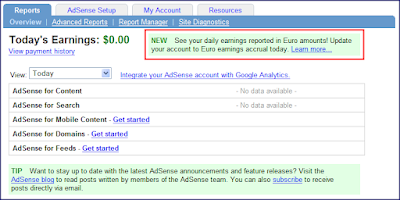
Before agreeing to the new Terms, we also recommend that you download and save copies of your past reports in U.S. Dollars for your records. Once you update your account, you'll be able to view current and historical reports only in Euros. However, you'll still be able to view your prior payment history of U.S. Dollar earnings.
We encourage you to update your account to local currency reports soon, as we may require this change in the future. If we're able to offer this to publishers in other countries, we'll provide details here on Inside AdSense. For more information, please feel free to visit our Help Center.
Get Goghing with AdSense for search
VanGoghGallery.com is an art resource site that provides information about the life and work of Vincent van Gogh. Site owner Greg Alexander runs the Van Gogh Gallery to educate and share information about the artist, and has also used the site to explore new Internet marketing techniques. Greg joined AdSense in 2007, and although he didn't know much about the program at first, he found it "a great opportunity to generate some revenue without spending the effort to sell ads." He also tried other ad providers, "but none of them yielded the results that AdSense did. In addition, AdSense was the only one that provided relevant ads for our visitors."
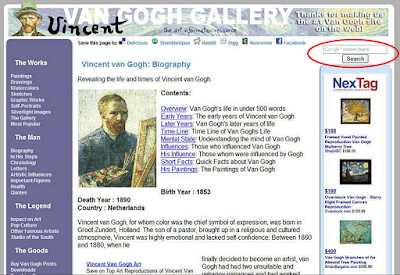
To help users navigate through the many pages of the Van Gogh Gallery, Greg added an AdSense for search box to the right column of his pages. By enabling SiteSearch and displaying search results on his own pages, he was able to help users find what they were looking for while staying on his site.
As an optimization experiment, Greg recently moved his search box to the center column of his pages and extended it to twice its original width.
Before
After

In addition, Greg made slight changes to the search results pages -- he removed the borders from the ads and search results, and added a new search box to the search results pages. According to Greg, "altogether, these changes took less than 15 minutes to do."
After making these updates, Greg noticed a dramatic and immediate increase in the usage of search on the Van Gogh Gallery. He found that "the number of queries performed each day increased 8 to 10 times, and search ad clicks and revenues increased even more." His search earnings quickly grew from less than a dollar a day to double digits since his optimization test. "Now we frequently receive more search ad clicks than our total number of searches pre-optimization," says Greg. "I'm still amazed at how simple changes can have such an incredible impact."
Greg has started using the earnings from his AdSearch optimization efforts to build and host additional websites about other artists. "Ultimately," Greg says,"we hope to use the earnings to fund research trips to Europe to see the works of the masters and expand the quality of information we offer visitors to our sites."
Fontastic new options for your ad units
There are a few ways to customize the font face of your ad units. If you'd like to quickly change the font settings for every ad unit generated from your account, visit the 'Ad Display Preference' section of your Account Settings page to select a new account-wide font face. This will affect all units you've created in the past, regardless of whether you used the Manage Ads feature. By default, your ads are currently set to 'Standard AdSense font family', which we've found has performed well across browsers and displays.

However, you can also select custom font faces for specific ad units that you've created with the Manage Ads feature. When creating new ad units, you'll be prompted to select between the default 'Standard AdSense font family', your new account-wide font face (if you've selected one), or another font face. You can also change the appearance of existing ad units, by visiting the Manage Ads page of your account and updating your font choices for specific ad units. Once you've changed the font face of an ad unit away from the default, those selections will be maintained even if you change your account-wide settings later.
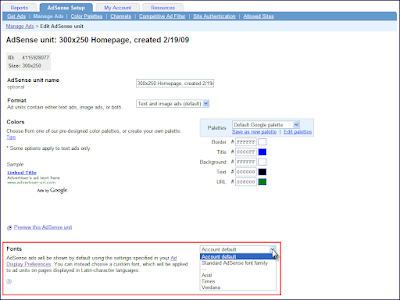
Just as with color and placement optimizations, we encourage you to test these new font options to find the best combination for your sites. For instance, you can try matching the font face of your ads to that of your sites. Enjoy the new font faces, and feel free to leave feedback in our comments field below.
Google AdSense Websites - Make Passive Income Without Any Clicks
Wednesday, May 27, 2009
My title is a pretty amazing title! Just how can your make an ad sense with ,AdSense websites make you a ton of money "Before" you get any clicks? No, Google has not changed it's terms of service overnight and is now paying for ad views rather than ad clicks
BUT...
A hot new program has launched that you can incorporate into your AdSense websites to ensure you 'Will" be making money before anyone clicks on one of your AdSense ads. That means you no longer have to wait until someone is bothered or motivated enough to click out before you can get some money in the bank. And making money, isn't that the whole reason you made an AdSense website in the first place?
This new feature that you can add to your website is a simple 5 second audio ad that plays automatically as a visitor enters your website and then shuts down just as quick as it started. It is so short it is being classed as unobtrusive however you can reap the rewards from those 5 seconds in the way of cold hard cash.
If this is the first time you have heard about this amazing new program called Pay Per Play then consider it to the first of many. Google AdSense money is going to become an advertiser in the shadows, as Pay Per Play takes centre stage for 2008. It has already muscled it's way into a position where almost every second a new member is signing up. Considering the following AdSense attracted with it's offer of no profits without clicks, just imagine how large the following is going to be for a program that pays for every visitor.
If you have websites, are always looking to increase your profits and like to be a couple steps ahead of the game then Pay Per Play is something you want to be checking out right now.
What are Google AdSense Ads?
For those of you who are into network marketing, Internet marketing, and website online marketing businesses, you're probably very familiar with Google AdSense. For those of you who keep seeing "make money with Google" marketing advertising and other marketing techniques, AdSense is what it's all about.
Google adwords has developed a plan to market advertising by being partners with website owners. That's it in a nutshell, you make money by placing small ads on your website that are pertinent to your website and get paid every time someone clicks on them.
To be more technical, Google AdSense develops small contextual ads to be placed on websites with full authority from the website owner. The ads, created by publishers who are selling products or services are created using AdWords and are SEO optimized to create traffic to other websites.
These two programs, Google and AdWords run hand in hand. When you enter terms into a search engine such as Google, you will see sponsored ads along the side. Any time that you click on one of those small ads, someone is paying and someone is receiving money. This is where the words pay per click come from. Those who are advertising reap benefits by paying small fees to Google to have their ads place in appropriate areas.
These pay per click AdSense ads create profits for those website owners outside of their online business. Although the percentage of split between Google and the website owner is not well known we can use 50% as an example. If an advertising agency is paying Google $.20 per click, then when their ad gets clicked on throughout the Internet, Google would get $.10, and the website owner where the ad appears gets $.10 as well. This is for every click, and if you have website traffic, it's going to add up
So what kind of ads will be placed on your website, it only makes sense to Google to place pertinent ads on your website. There's no sense placing a horse medicine ad on a women's fashion website. So all of the ads are screened before they come to your site for pertinent, relative, unique content. This means that not only do you make attractive advertising links on your website, but can actually generate more traffic to your website because you have pertinent information.
Some advertising from AdSense plays better than others, this is because publishers bid on keywords and are willing to pay a certain amount of money for each one of them. How much money they're willing to bid is a bit of a trade secret, but you can bet that some of those AdWords are being paid for at $50 a click.
Now that you have the basics on what AdSense is all about, if you have traffic running through your website, you might as well make money. You can contact AdSense via a search engine search, or go direct to Google and follow a link. There's no sense in not optimizing your website for profits by using AdSense.
Google AdSense A Win-Win For Advertisers and Webmasters
Google AdSense is a revenue generating program for webmasters and a marketing campaign for advertisers. Google serves as a bridge between the products and the customers. The business men who want to sell their products are searching for markets to advertise them. When their advertisements reach more people then they are likely to get more customers for their products. The webmasters who own websites are searching for opportunities to make money using their website. Google perfectly understands the need of both the ends and beautifully connects them by means of AdSense.
The business owners or advertisers in Google's perspective register their ads with Google AdSense ads. Google does some research on the ads and if the ads are found legal, then they will be published by Google in the websites whose owners are interested to place them. The advertisers pay Google for sending customers for their websites. Google pays a part of this money to all the webmasters who send their visitors to the advertiser's websites.
The advertisers must register for advertiser's account with AdSense. After approving the target website and the ads you can place the bid for the main keywords of your ads. The highest bidder wins the keywords. The bid is specified as the amount paid per click. When you compete for a hot keyword, you have to bid more. But when you bid for a more targeted but less liked keyword, you can win the bid for a lower amount.
The webmasters must register for an account with Google AdSense. After approving your website, Google will then crawl your website to find the main keywords to place relevant ads on your website. Although you can assist Google to place relevant ads by specifications and blocking you cannot decide exactly what ads will appear on your website. You will be paid when your visitor clicks on the ads and views the advertiser's website.
Google has strict privacy policy. The advertisers do not know on whose websites their ads are placed and the vice versa is also true. Google decides everything. If any illegal activity is found with the webmaster or advertiser Google has the right to deactivate the account. All your contacts regarding AdSense must be only with Google. If you find anything suspicious about your ads or website, you must report only to Google.
To be a part of Google AdSense program you must be atleast 18 years of age. When you apply for the program you have to fill in the application from correctly otherwise you will be disapproved by Google. Once disapproved, you can never get approval for the same website from Google. Google adds disapproved websites in a black list and you will be denied forever. Google does not allow any communications directly between the advertiser and the webmaster. Any illegal dealings are not allowed. Google AdSense does not guarantee the number of customers to the advertisers and doest not guarantee the revenue for webmasters. It all depends on your own ability and skills to attract visitors.
Fraudulent or computer generated clicks are not allowed by Google. Google AdSense comprises of a special team of members that watch all the websites registered with Google for any fraudulent activity. Google is very strict with its policies and you will be disapproved without any clarification if any illegal activity is found. Google never cheats the advertisers and you need to pay Google only if a valid click is generated out of your ads.
Google AdSense is a grate program that is beneficial to both advertisers and webmasters. If you are genuine and clean you will definitely love Google AdSense program. It is always a Win -Win for both the ends. So if you have a running website then you can surely monetize your website with AdSense to taste the passive income which does nit require any extra effort.
Top 15 AdSense tips
AdSense Tip #1: Find your keywords
Before serving ads on a web page, check its keyword density. A free and advanced tool for finding the most prominent keywords in a page can be found here: SEO Density Analyzer. Copy the most important keywords to a text file ([web page name]-adsense-keywords.txt).
AdSense Tip #2: Improve your keywords
Get keyword suggestions from Overture Search Inventory and from Google AdWords Sandbox. Get new keywords that can help you improve your ad relevance. Enter the keywords from [web page name]-adsense-keywords.txt and save the suggestions to [web page name]-adsense-suggestions.txt.
AdSense Tip #3: Keep your website focused on a theme
Use the keyword suggestions to enhance your web pages and to build theme-based content. And also try to get your keywords into the anchor text of your incoming links as much as possible. Don't forget that Google AdSense is keyword-targeted advertising: Google AdSense bases its advert topics on your websites content, this means that content-rich websites of a popular topic should attract a large amount of ads.
AdSense Tip #4: Write a new page every day
One of the best tips is to add a new page to your web site every day. The more content you have, the more visitors you will get. Put an Adsense unit on each and every content page of your site. But where? You will find more about that from the next AdSense tips.
AdSense Tip #5: Choose the right AdSense format
Wider formats are successful because the ads are compact, easy to read and are complementary to the content. The top three AdSense formats are:
- 336x280 large rectangle
- 300x250 medium rectangle
- 160x600 wide skyscraper
Another successful format is the 468x15 horizontal ad links, that can be placed under your navigation bar.
In part one of the AdSense tips you found out how to improve your keywords and how to build theme-based content.
- AdSense Tip #1: Your keywords are important
- AdSense Tip #2: Improve your keywords
- AdSense Tip #3: Keep your website focused on a theme
- AdSense Tip #4: Write a new page every day
- AdSense Tip #5: Choose the right AdSense format
The next AdSense tips will show you the importance of positioning the ads and how to increase your revenue by adding multiple AdSense units.
AdSense Tip #6: Color tips
When creating your Google AdSense ads it is recommended to use the color scheme and style of your website so that the ads blend in well. Ads without background color and borders perfom better than ads within borders with background color.
Create a custom AdSense palette:
- border color = background color of your web site
- background color = background color of your web site
- link color = blue, color of your links
- url color = black, #999999
- text color = black, #333333, color of your main content
AdSense Tip #7: Position tips
Visitors tend to look at the big headlines to see if your page is worth reading. If you get them interested, they will read the text and look for your navigation links.
Place the AdSense ads in a prominent place around the top/left part of your page or under your headlines, where your visitors are most likely to look at.
If you have an article page with a long body of text, the bottom of that article is a good place for AdSense ads because your visitors read the text and then they want more resources.
AdSense Tip #8: Increase the number of ads, but not too much
If you have a lot of text on a page, use multiple AdSense units. You can use up to three AdSense units on a page, two AdSense search boxes and one unit of ad links.
Link units allow the user to refine what they're interested in. So if they may not be interested in specific ads on your page, they might be interested in a particular topic, and by clicking on a link unit and a link in the link unit, they'll be able to specify that they're interested in that specific topic and get a lot more options and variety on the ads that might appear.
AdSense for Search allows visitors to search Google.com or your sites (up to 3 domains). You earn money whenever they click on the ads that come up on the search results. If you click the Open search results in a new browser window checkbox in the AdSense for Search settings, you won't lose your visitors.
AdSense Tip #9: Preview Google ads
You can find out what ads will be served by Google AdSense if you install Google AdSense Preview Tool, a very simple tool available only for Internet Explorer 6.0. Click to advertiser sites without generating invalid clicks, and easily add their URLs to your URL filter list. Because AdSense uses geo-targeting, Google serves different ads for other countries. Instead of faking your IP or travelling abroad to test your ads, use this AdSense tool to see what ads see your visitors from France, Germany or other countries.
There may be no Google AdSense ads available for your webpage, so Googlw will display Public Service Ads. You can hide them using alternate colors or images. Make sure you include the image in a simple html file as a link (use target="_top"). The image size should be the same as the dimension of AdSense units. In the alternate url box, enter the absolute url of the html file.
Read more about alternate ads.
AdSense Tip #10: What not to do
- Don't click on your own ads
- Don't ask others to click on your Google ads
- Don't manually change AdSense code
- Don't place Google ads on sites that include prohibited content (e.g.: adult sites)
- Don't employ cloaking, hidden text or farm links
- Don't use AdSense ads on the same page with similar ads (e.g.: Yahoo Publisher Network)
In part one of the AdSense tips you found out how to improve your keywords and how to build theme-based content.
Then we showed you the importance of positioning the ads and how to increase your revenue by adding multiple AdSense units.
AdSense Tip #11: Show images above or next to your ads
Placing images above AdSense ads is not necessarily prohibited by program policies. However, depending on the method of implementation this could be considered encouraging users to click on ads. So you should include a border line between the ads and the images. Don't show specific products in your images, in order not to mislead the visitors. Just use generic images that will increase the visibility of your ads.
AdSense Tip #12: Use section targeting
Use section targeting to emphasize some content in your page. On your site, place this code where you want to emphasize.
Content you want to emphasize.


If you want some content to be ignored, use
AdSense Tip #13: Alternate the colors of your ads
AdSense allows you to have up to 4 color variations for each variable for which you can specify color. You should do that if you put AdSense ads on pages that receive many impressions from the same visitors (for example forums) to reduce ad blindness. For example:
google_color_border = ["628098","628098","000000","000000"];
google_color_link = ["000000","BBB90C","BBB90C","628098"];
google_color_url = ["000000","628098","000000","000000"];
google_color_text = ["628098","628098","000000","000000"];
AdSense Tip #14: Your Google ads should be visible
Make sure your text ads are visible to the surfers in all screen formats. If you put the ads in a table, give sufficient breathing room, i.e. proper cell padding and cell spacing to make the ads stand out from the rest of your content.
AdSense Tip #15: Use AdSense channels
You can categorize the content of your website into channels and then track your performance. This way you can experiment with different types of ads and see which is performing the best. Instead of buying an AdSense tracker, you can enter the most important pages in your site and see how they are doing. Create up to 200 channels for AdSense.

Let's recap our AdSense tips
- create interesting to read pages, focused on a theme
- integrate AdSense in your layout
- put yourself in the shoes of your visitors and experiment with the ads
Google AdSense
Google AdSense is a pay-per-click (PPC) program that can give you advertising revenue from each page on your website with a minimal investment in time and no additional resources.
AdSense delivers relevant ads that are targeted to the content people find on your site.
In many advertising networks and websites, including AdSense, the advertiser is charged for advertising their ad only when a user clicks on their ad. How much they pay (for that click) is called their Cost Per Click or CPC.
Here you will find some simple and effective AdSense tips that will increase your revenue. If you haven't already joined AdSense program, you should sign up first.
AdSense delivers relevant ads that are targeted to the content people find on your site.
In many advertising networks and websites, including AdSense, the advertiser is charged for advertising their ad only when a user clicks on their ad. How much they pay (for that click) is called their Cost Per Click or CPC.
Here you will find some simple and effective AdSense tips that will increase your revenue. If you haven't already joined AdSense program, you should sign up first.
Now it's time to show you some tips and tricks that will optimize your AdSense ads.

