Showing posts with label Google Ad Manager. Show all posts
Adbrite will aso pay you money like GOOGLE ADSENCE.!!!!...HURRY!!!!!

Inside...Google Ad Manager
Sunday, December 20, 2009
In March 2008, we launched Google Ad Manager, our ad management solution for publishers with small direct sales teams. Following the rapid growth of this product, we're excited to announce that we're now devoting a new blog to Ad Manager at http://googleadmanager.blogspot.com . The Ad Manager team has lots of information to share, and we encourage you to visit the new blog for the latest Ad Manager news, tips, and resources.
For those of you new to Ad Manager, it can help you sell, schedule, deliver, and measure all of your directly-sold and network-based ad inventory. It offers an intuitive and simple user interface, Google serving speed and reliability, and significant cost savings. Best of all, Ad Manager can be optionally integrated with AdSense to offer you an automated way to maximize the revenue of your unsold and network-managed inventory. If you don't have an account yet, visit http://www.google.com/admanager. We also recommend looking through our two-part series on getting started.
Thanks for following our Ad Manager posts here on Inside AdSense for the past year; we hope that you'll stop by and visit the new Ad Manager blog for the latest announcements and tips.
For those of you new to Ad Manager, it can help you sell, schedule, deliver, and measure all of your directly-sold and network-based ad inventory. It offers an intuitive and simple user interface, Google serving speed and reliability, and significant cost savings. Best of all, Ad Manager can be optionally integrated with AdSense to offer you an automated way to maximize the revenue of your unsold and network-managed inventory. If you don't have an account yet, visit http://www.google.com/admanager. We also recommend looking through our two-part series on getting started.
Thanks for following our Ad Manager posts here on Inside AdSense for the past year; we hope that you'll stop by and visit the new Ad Manager blog for the latest announcements and tips.


Your introduction to Google Ad Manager (Part 1 of 2)
Monday, October 19, 2009
What is Google Ad Manager?
Google Ad Manager is a hosted ad management solution for publishers with smaller direct sales teams; it can help you sell, schedule, deliver, and measure all of your directly sold and network-based inventory.
Should I use Ad Manager?
You'll probably want to use Ad Manager if:
- You operate a website and sell your ad inventory directly to advertisers (or plan to sell directly to advertisers in the future).
- You'd like to improve the efficiency of your sales process and feel confident in your forecasting.
- You've been left with unsold inventory because you weren't able to forecast availability accurately.
- You need a consistent way to serve ads that make you the most money in undersold situations.
- A simple, intuitive user interface: you can manage your campaigns, inventory, and advertiser data quickly and efficiently.
- Revenue optimization and AdSense integration: the system will consistently deliver the highest-paying ad for every ad impression on your site.
- Precise inventory forecasting: you'll be able to sell more of your inventory without overbooking it.
Using AdSense with Ad Manager on your websites can help you maximize your revenue in a number of ways. You can use AdSense to backfill all of your unsold inventory, ensuring that all of your ad spaces are filled. AdSense can also be used as a competing network against your other networks -- AdSense can compete with your remnant and house campaigns to deliver the highest value ads, and an AdSense ad will only show if it can pay you more than any alternative ads.
Moreover, since AdSense is integrated in your Ad Manager account, the only thing you need to do is to choose the Ad Slots for which you want to enable AdSense. You can modify your AdSense settings within Ad Manager, and you can manage your visibility to advertisers by using the placement targeting feature.
How do I get started with Ad Manager?
You can create an account by visiting the Ad Manager homepage and using your AdSense login. Once you've done so, don't forget to visit our Help Center for detailed instructions and video tutorials on getting started. We also recommend taking a look at how Ad Manager works.
In Part 2 of this series, we'll help you get accustomed to your new Ad Manager account and guide you through the creation of your first campaign. We're also hosting a Getting Started with Google Ad Manager Webinar on April 21st at 11:00 am PDT, where we'll give a live demo of Ad Manager, share best practices, and help you get started. Sign up at: https://googleonline.webex.com/googleonline/onstage/g.php?t=a&d=570486361.
Your introduction to Google Ad Manager (Part 2 of 2)
In addition to the tips below, we'll be hosting a Getting Started with Google Ad Manager Webinar on April 21st at 11:00 am PDT, where we'll give a live demo of Ad Manager, share best practices, and help you get started. Sign up at:
https://googleonline.webex.com/googleonline/onstage/g.php?t=a&d=570486361.
What terms do I need to know in my Ad Manager account?
With Ad Manager, you'll manage all of your inventory according to the following terminology:
- Ad Slot: This is the most granular inventory component, and represents the location of an ad. It's the equivalent of an ad unit in AdSense. For instance, you can set up an ad slot for the top banner on your pages.
- Placement: This is a publisher-defined collection of ad slots, and represents inventory to be sold. In AdSense, this is the equivalent of an ad placement . You should include at least one ad slot per placement, as campaigns are all linked to a placement. For instance, you can create a placement for all of your ad slots on your sports pages, or the top banners on all pages of your site.
- Order: This is a summary containing information about an ad campaign including the campaign dates, the advertiser or agency, and the contact numbers.
- Line Item: You’ll enter all the details of an ad campaign including the flights dates, the cost, the priority level, the targeting criteria, and the delivery information.
- Creative: This is the actual media being delivered in your ad slots.

I'm ready to start using my Ad Manager account. How do I serve my first campaign?
There are three parts to serving your first campaign: setting up your inventory, tagging your pages, and creating your campaigns. Follow our three-part guide below for instructions:
A. Setting up your inventory
There are two main steps to follow to organize your inventory. In the Inventory tab, you’ll need to:
- Create your ad slots: At this stage, you can choose to enable AdSense Optimization in order to fill your unsold inventory with AdSense and to make it compete with your ad networks. The baseline for the competition is the Value CPM that you set for your networks.
- Group your ad slots into placements: In order to allow advertisers to target their campaigns to your specific placements, you'll need to enable placement targeting.
Once you've set up your inventory in Ad Manager, you’ll need to tag every page on which you want to use Ad Manager to deliver your ads. For each page, you’ll need to define all the ad slots that should appear and generate html code:
- Go to the Inventory tab and click on “Generate HTML code”.
- Select the Ad Slots you want to appear on the page you’re tagging
- Generate the code and use it to tag your page
C. Creating your campaigns
Once your inventory is ready and your pages are tagged, then you can start creating your campaigns. To manage your campaigns, you should always refer to the Order tab. Here are the 3 key steps to remember in order to create a campaign:
- Create the advertiser’s Order: Choose between the Default Order (for Directly sold inventory) and the Ad Network Order.
- Create the advertiser’s Line Items
- Select a level of priority (there are 5 different levels)
- Select a cost type: CPC, CPM, CPD
- Specify goals and settings, such as targeting, daily and user capping, and creative rotation.
- Upload the creatives
- Select the creative type (we currently support Flash, Image and Rich Media)
- Choose to add a click macro or a cache buster
- Test the creative in the preview tab or directly on your website
Pageview tracking back to normal
Please be assured that ad unit impressions were still logged correctly and ads were still displayed on your pages, so you were properly credited for all earnings generated from your ads. We've resolved the issue, and although you won't see the pageview count in your reports retroactively changed, your pageview tracking is now back to normal.
Thanks for your patience and your help in identifying this bug.
AdSense is a-Twitter
We're thrilled to launch @adsense to communicate with AdSense publishers who use Twitter. Our tweets will be a mix of fresh product news, optimization tips, interesting links, upcoming events, and possibly even pictures of our dogs. Our entire AdSense team contributes, so if you have any suggestions for what you want to see, feel free to send an @reply to us!
Please note that since we want to make this feed as useful as possible to everyone following us, we can't respond via Twitter to questions regarding individual AdSense accounts. Please continue to visit the AdSense Help Center and Help Forum to troubleshoot your specific issues.
Driving monetization with ads that reach the right audience
Over the next few months we'll start offering interest-based advertising to a limited number of advertisers as part of a beta, and expand the offering later in 2009. Whether the advertiser's goal is to drive brand awareness or increase responses to their ads, these capabilities can help expand the success of their campaigns and should increase your earnings as advertiser participation increases.
To develop interest categories, we'll recognize the types of webpages users visit across the AdSense network. As an example, if they visit a number of sports pages, we'll add them to the "sports enthusiast" interest category. You can visit the Help Center to learn more about how interest categories will be developed and your associated account settings. As a result of this launch, your privacy policy will now need to reflect the use of interest-based advertising. Please ensure that your site's privacy policies are up-to-date and make any necessary changes by April 8, 2009.
Users browsing the web will benefit from the additional relevancy that interest-based ads can provide. And by visiting the new Ads Preferences Manager, users can see what interest categories we think they fall into, or add and remove categories themselves. The Ads Preferences Manager can be found by clicking on most "Ads by Google" links you see on Google ads throughout the web.
You can read more about how interest-based advertising benefits the online ecosystem and about the privacy innovations developed for this launch in the Official Google Blog and the Google Public Policy Blog.
We look forward to providing users with ads more closely tied to their interests, helping advertisers reach their campaign goals, and helping you to monetize your website most effectively.
Answers to your interest-based advertising questions
How should I update my privacy policies?
Your site's privacy policy will need to include the information mentioned in this Help Center entry. However, because publisher sites and laws vary by country, we're not able to provide exact language for your site. Please make any necessary changes to your privacy policies by April 8th, 2009, as the official launch of interest-based advertising will occur on April 9th. If you're a blogger, you can paste your privacy policy into your sidebar.
I noticed some changes in my earnings and the ads showing up on my site -- is it because of interest-based ads?
No. We haven't yet launched interest-based ads on AdSense publisher sites, so there's been no effect on your revenue or the ads appearing on your pages. Interest-based advertising will be rolled out to a limited set of advertisers beginning on April 9th, and then expanded later this year; as a result, the impact of this launch for most publishers won't be immediate. Over time, as interest-based advertising is rolled-out to additional advertisers, you should begin to see positive effects on your revenue.
Does this mean that my sites won't show ads relevant to my content anymore?
No, that's not the case -- interest-based ads won't replace the previous ad targeting options you're used to. Interest-based ads will compete in the same ad auction as contextually- and placement-targeted ads, and we'll continue to show only the ad(s) that will generate highest earnings for you. As noted above, interest-based ads will gradually become available to show on publisher pages, and with more available ads competing in the ad auction, you should see increased earnings over time.
Are these interest-based ads pop-ups?
No, Google doesn't show ads as pop-ups.
If I opt out of showing ads based on interest categories, can I change my mind later? Will I still need to update my privacy policy now?
Yes, you can change your preferences around displaying ads based on interest categories at any time. However, even if you choose to opt out of displaying ads based on interest categories now, you'll still need to update your privacy policies by April 8th. This is because your site may still show ads based on a user's previous interactions with an advertiser, such as past visits to that advertiser's site. Please keep in mind that remaining opted in to displaying ads based on interest categories will help increase the number of available ads for your pages in the long run, which can help increase your earnings potential.
AdSense for content bug now fixed
Our engineers have now resolved the issue and have confirmed that ad targeting has returned to normal. We apologize for this issue; please know that our engineers are performing a thorough analysis of what occurred and will make changes to prevent similar problems from happening in the future.
Introducing expandable ads on AdSense sites
We're excited to introduce to you expandable ads, a new type of ad that can appear on your pages. Expandable ads are rich media ads that can expand beyond the original size of the ad unit, following a user-initiated action. This creates more real estate for the ad, allowing for more interaction from interested users. For instance, expandable ads may stream a movie trailer, show video game clips, or display various views of an item for sale.
Expandable ads will be served as third-party ads and will be created by Google-certified rich media vendors for the top display advertisers in our network. And like other Google ads, you'll earn based on whether the expandable ads on your site are priced on a cost-per-click (CPC) or cost-per-impression (CPM) basis. Keep in mind that you'll generate earnings from CPC expandable ads when a user visits the advertiser's landing page, and not when a user simply clicks to expand the ad.

We thought you might have more questions about the launch of expandable ads, so we've addressed a few key points below:
Will expandable ads alter my site's layout or be disruptive to my users?
No. In order to protect the publisher and user experience, we've created several policies around how expandable ads work:
- Ads will expand only after a user clicks and interacts with the ad. Mouseovers or rollovers won't trigger the ad, in order to prevent accidental expansions.
- An expandable ad won't expand more than double its width or height.
- Once expanded, the ad will appear as a layer over the page content so that your content will not be modified or shifted in any way.
- The user may close the expanded panel at any time.
- All expandable ads must comply with our standard AdWords image ad policies.
You're automatically eligible to receive expandable ads if you've added the AdSense code directly into your site's source code and you've enabled image ads. Please note that expandable ads are currently only available to specific advertisers located in the U.S., who can bid on specific sites where they'd like their ads to appear.
You won't need to upload any special "iFrame-buster" files from third-party vendors onto your own servers to allow these new types of ads to expand on your site. Although we don't currently offer expandable ads for all ad serving solutions, we're actively working to support more implementation methods soon, and we thank you for your patience in the meantime.
Can I filter specific expandable ads shown on my site?
Yes - like the other ads on your pages, you can use your Competitive Ad Filter to block contextually-targeted expandable ads. Please note that for third-party ads, we recommend using the top level domain (e.g. 'example.com' instead of 'example.com/sample.html'). Additionally, you'll still be able to use your Ad Review Center to block specific placement-targeted expandable ads. In the Ad Review Center, expandable ads will be classified under the "Rich Media" ad format.
Updates on account access and reporting
Login loop
If you tried to sign in to your AdSense account between 10:45 and 11:35 p.m. PST last night, you may have found yourself in a "loop" between the AdSense login page and your Google Accounts page. We're in the process of trying out some new designs for our US English homepage, and we rolled them back after users reported a login error with one of the designs. If you're still having trouble accessing your account, please clear your cache and cookies and then try logging in again at http://www.google.com/adsense. Rest assured the next time the new designs are rolled out, you'll actually end up where you want to be: in your AdSense account! Thanks especially to the forum posters and Twitterers for quickly bringing this to our attention.
Slower stats
You may notice more of a delay in your AdSense and Google Ad Manager stats than usual today, as our engineers will be performing some maintenance work on our system. Please be assured that ads will continue to be served to your pages, and all activity will continue to be tracked as usual. Although it may take longer than usual to see impressions, clicks, and earnings reported in your account, you'll be credited for all valid activity on your sites. We apologize for the short notice, and appreciate your patience as we work to keep our systems updated for you.
Reports have gone international
If you're located in one of these five countries and make this update, we'll convert your earnings to Euros on a daily basis using the prevailing market rate from the previous day. With earnings converted daily, you'll avoid the risk of currency exchange fluctuations between USD and the Euro. You can still choose to receive payments in either Euros or U.S. Dollars and select from a range of payment methods as well.
To make the switch to local currency reports, you'll need to agree to a new set of Terms and Conditions. Here are the main changes involved:
- The party that publishers are contracting with changes from Google Inc. to Google Ireland Limited.
- Publishers are responsible for paying any local taxes in their jurisdiction. Google will only issue VAT refunds to publishers with an address in Ireland.
- The governing law changes from California law to either English or local law.
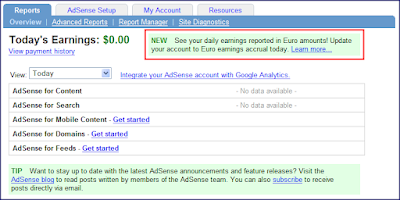
Before agreeing to the new Terms, we also recommend that you download and save copies of your past reports in U.S. Dollars for your records. Once you update your account, you'll be able to view current and historical reports only in Euros. However, you'll still be able to view your prior payment history of U.S. Dollar earnings.
We encourage you to update your account to local currency reports soon, as we may require this change in the future. If we're able to offer this to publishers in other countries, we'll provide details here on Inside AdSense. For more information, please feel free to visit our Help Center.
Get Goghing with AdSense for search
VanGoghGallery.com is an art resource site that provides information about the life and work of Vincent van Gogh. Site owner Greg Alexander runs the Van Gogh Gallery to educate and share information about the artist, and has also used the site to explore new Internet marketing techniques. Greg joined AdSense in 2007, and although he didn't know much about the program at first, he found it "a great opportunity to generate some revenue without spending the effort to sell ads." He also tried other ad providers, "but none of them yielded the results that AdSense did. In addition, AdSense was the only one that provided relevant ads for our visitors."
To help users navigate through the many pages of the Van Gogh Gallery, Greg added an AdSense for search box to the right column of his pages. By enabling SiteSearch and displaying search results on his own pages, he was able to help users find what they were looking for while staying on his site.
As an optimization experiment, Greg recently moved his search box to the center column of his pages and extended it to twice its original width.
Before
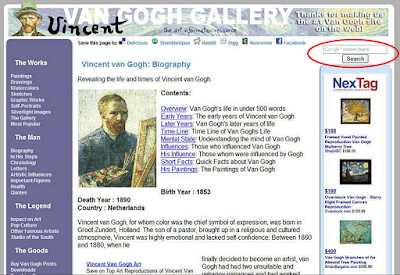
After

In addition, Greg made slight changes to the search results pages -- he removed the borders from the ads and search results, and added a new search box to the search results pages. According to Greg, "altogether, these changes took less than 15 minutes to do."
After making these updates, Greg noticed a dramatic and immediate increase in the usage of search on the Van Gogh Gallery. He found that "the number of queries performed each day increased 8 to 10 times, and search ad clicks and revenues increased even more." His search earnings quickly grew from less than a dollar a day to double digits since his optimization test. "Now we frequently receive more search ad clicks than our total number of searches pre-optimization," says Greg. "I'm still amazed at how simple changes can have such an incredible impact."
Greg has started using the earnings from his AdSearch optimization efforts to build and host additional websites about other artists. "Ultimately," Greg says,"we hope to use the earnings to fund research trips to Europe to see the works of the masters and expand the quality of information we offer visitors to our sites."
Talking AdSense optimization in Google Ad Manager
It can be tough to sell advertising in today's economy. It can be even tougher to figure out how to maximize revenue for each ad impression. Google Ad Manager, our hosted ad serving and management solution for publishers with small direct sales teams, was built to address these issues. Ad Manager helps publishers maximize the value of their ad impressions while reducing ad serving costs.
We enlisted the help of Nandu Ramani, Engineering Lead on Ad Manager, to talk about one of Ad Manager's features that helps publishers maximize the value of their ad impressions: AdSense price optimization.
What is the AdSense price optimization feature in Ad Manager?
 Many publishers don't sell all of their ad inventory. In these situations, publishers might not serve any ads or might serve less valuable house ads, therefore losing potential earnings. The AdSense price optimization feature in Ad Manager provides an automated solution so publishers will always have an ad to serve in an undersold situation.
We also wanted to make sure that when a publisher runs multiple ad networks they are always showing the most valuable ads. For certain individual impressions, AdSense can provide the highest paying ad. When that's the case, an AdSense ad shows. When that's not the case, an ad from the highest paying alternative network will be shown.
How does the price optimization feature work?
In order for AdSense to compete against other ad networks, a publisher must manually enter a CPM for each configured network. We use the CPM entered to determine in real time, on a per impression basis, whether or not an AdSense ad will pay a publisher more. If the AdSense eCPM is greater than the CPM value entered for competing networks, then an AdSense ad will be shown. Additionally, AdSense will never compete with a publisher's directly-sold inventory. To enable the price optimization feature, all a publisher has to do is check a box when setting up inventory.
As a publisher, how much will I earn using AdSense price optimization?
It's hard to predict; the best way to find out is to opt your ad slots into AdSense price optimization and see how AdSense performs for you. With AdSense price optimization, Google will always serve the highest paying AdSense ad available, and will never lower the price of the winning ad, or reduce your earnings from it.
When should I use the AdSense price optimization feature?
We suggest you opt all of your ad slots into AdSense price optimization. AdSense ads will only appear if they're able to pay you more than the alternatives, so there's no risk of losing revenue.
We also recommend that you opt your premium placements into placement targeting so AdWords advertisers may specifically choose to bid for space on your website.
Sounds good. How do I get started?
If you already have an Ad Manager account, go into the inventory tab in your account. For each ad slot where you want to enable AdSense price optimization, click on the name of the ad slot, check the 'Maximize revenue of unsold and remnant inventory with AdSense' checkbox, and click 'Save.'
If you don't already have an account, get started today at http://www.google.com/admanager. Then, when you're setting up your inventory, make sure to opt all of your ad slots into AdSense price optimization.
For more information about AdSense in Ad Manager, check out the following video.

